
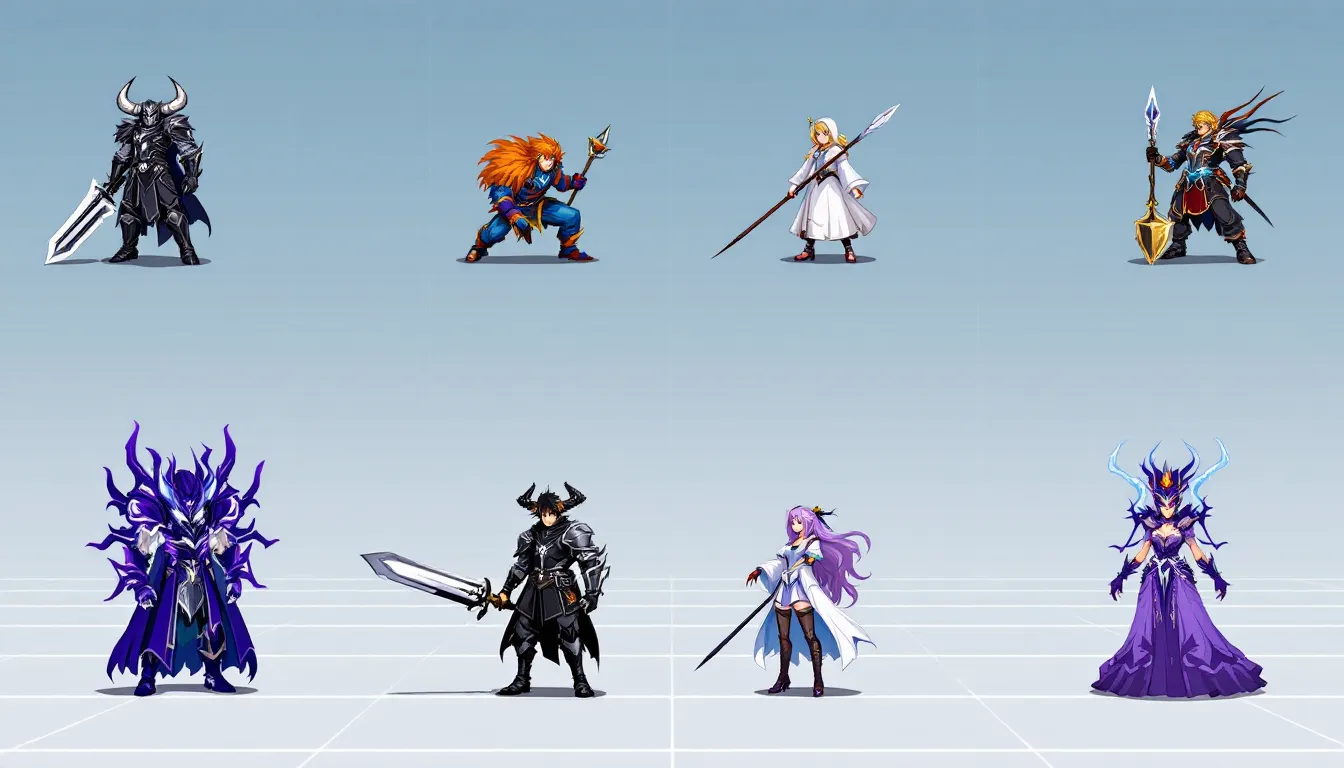
Final Fantasy 4 stands as one of the most visually influential RPGs ever created, and its sprites are a massive part of that legacy. Released on the SNES in 1991 (Japan) and 1992 (North America), FF4 elevated pixel art to an art form, each character sprite tells a story through color, animation, and incredibly constrained technical limitations. Whether you’re a veteran who played it on original hardware, a modern gamer discovering it through remakes, or someone curious about how developers squeezed so much personality out of 16-bit technology, understanding FF4’s sprite work is key to appreciating why this game still holds up decades later. This guide dives into everything about Final Fantasy 4 sprites: from the original SNES designs to modern reimaginings, the technical wizardry behind their creation, and the thriving community of modders who continue to push these sprites in wild new directions.
Table of Contents
ToggleKey Takeaways
- Final Fantasy 4 sprites defined 16-bit RPG visual design by achieving memorable character recognition within 32×32 pixel constraints and limited color palettes, influencing generations of developers.
- Cecil’s transformation from Dark Knight to Paladin, Kain’s iconic dragoon armor, and Rydia’s child-to-adult evolution demonstrate how sprite design conveyed character development without dialogue.
- The technical mastery behind FF4 sprites—carefully managed color gradients, 4-8 frame animations, and pixel-level precision—proved that artistic limitations drive creative innovation rather than hinder it.
- FF4 sprite modding communities remain active decades later, using tools like YY-CHR to create upscales, redesigns, and enhancements that prove the original sprite framework remains viable for modern projects.
- Modern indie RPGs like Undertale and Chained Echoes explicitly cite FF4 sprites as inspiration, while pixel art continues to be studied in game design curricula, cementing FF4’s status as a historical and educational artifact.
- The evolution of FF4 sprites across platforms—from SNES to PlayStation to the Pixel Remaster—shows how hand-crafted sprite aesthetics endure and remain more timeless than early 3D interpretations.
What Are Final Fantasy 4 Sprites?
Final Fantasy 4 sprites are the 2D pixel-based character and creature graphics that make up the visual foundation of the game. Unlike modern 3D models, sprites were hand-drawn and limited by hardware constraints: the SNES could only display a certain number of colors per sprite, a fixed resolution, and limited animation frames. A typical character sprite in FF4 occupied roughly 32×32 pixels on screen, yet artists managed to convey personality, armor design, weapons, and emotional expression within that tiny canvas.
Think of them as the building blocks of the entire game world. When you saw Cecil in his Dark Knight armor, that wasn’t a 3D model, it was a painstakingly animated sprite showing his dark cloak, sword, and crown. The same applied to enemies, bosses, NPCs, and environmental characters. Everything moved using frame-by-frame animation, sometimes using just 4-8 frames to create the illusion of smooth motion.
The brilliance of FF4’s sprite work lies in its clarity and character design. Even at tiny sizes, you instantly recognized who you were looking at. Rosa’s white mage robes, Kain’s dragoon spear, Rydia’s summoner staff, each design choice was intentional and readable at a glance. This remains one of the high-water marks of 2D RPG visual design.
The Evolution of FF4 Sprite Design Across Platforms
Original SNES Release and Pixel Art Style
The original SNES version of Final Fantasy 4 (called Final Fantasy II in North America at launch) featured 256-color palettes split across various sprites and backgrounds. The development team at Square, led by character designer Yoshitaka Amano’s vision and brought to pixel life by the graphics team, had to work within brutal technical boundaries. Animation was kept economical, idle stances used 2-4 frames, attack animations perhaps 8-12 frames max. Movement was restricted to four directional views or side-view battle stances.
Even though these constraints, the artistry shines through. The shading and color gradients create depth and form. Cecil’s two sprite forms (Dark Knight and Paladin) were completely separate designs, both readable and distinct. Enemy sprites ranged from simple slimes to intricate mechanical constructs, each with personality baked into their limited pixel count.
PlayStation and GBA Enhancements
When FF4 hit the PlayStation in 1997, Square had a chance to modernize the visuals. They didn’t replace the sprites entirely, instead, they upscaled and smoothed them, updated backgrounds, and reintroduced the original Japanese script (the SNES had significant story changes). The sprites retained their original pixel-based charm but with enhanced colors and slightly more detail.
The Game Boy Advance version (2005) was more of a technical marvel. Working with significantly weaker hardware than even the SNES, developers downscaled sprites further while maintaining readability. This version, called “Final Fantasy IV Advance,” became the definitive portable experience and proved that strong character design survives even aggressive compression.
3D Remasters and Modern Interpretations
The 2007 Nintendo DS version of FF4 took a massive leap: it rendered the game in full 3D, complete with rotating camera angles and polygonal character models. The sprites were gone, replaced with tiny 3D avatars. While this modernized the look, something intangible was lost, the stylized, hand-crafted nature of the sprites gave way to more generic 3D proportions.
The 2D remake (also on DS, released as “Final Fantasy IV Complete Collection” in the West) returned to sprites but used enhanced, hand-drawn versions at higher resolution. This version has become a favorite among fans who wanted the convenience of modern platforms without sacrificing the classic visual identity. The sprites here were redrawn and smoother, losing some of the chunky 16-bit charm but gaining clarity.
Today, the “Pixel Remaster” versions on PC, console, and mobile (released 2021 onwards) represent the latest sprite evolution. These feature completely redrawn artwork while maintaining the sprite-based aesthetic. They’re sharper, more expressive, and better animated than the originals, a middle ground between honoring the classic look and updating it for modern standards.
Main Character Sprites and Their Iconic Designs
Cecil’s Dark and Light Knight Transformation
Cecil Harvey is the face of FF4, and his sprite work perfectly reflects his journey. In the early game, he’s the Dark Knight, clad in black armor with a distinctly menacing silhouette. His sprite features a dark cape, horns on his helmet, and a broadsword, every element screams antagonistic, fitting his role as a conflicted villain-turned-hero.
When Cecil transforms into a Paladin roughly halfway through the game, his entire sprite changes. Gone is the dark cape: in its place is gleaming white and silver armor with a holy symbol. The helmet loses its menace, gaining a more noble appearance. This visual change matters immensely, the sprite transformation reinforces his character arc without a single line of dialogue. The animation work on Cecil’s idle stance also shifts slightly, becoming more dignified in Paladin form.
The combat animations for Cecil are equally impressive. His sword swing frames show weight and momentum. Dark Knight’s Dark Wave ability had him pulling energy from his weapon, while Paladin’s Holy channeled light from above, both conveyed through sprite positioning and visual effects.
Kain’s Dragoon Armor and Lance Animations
Kain Highwind has one of the most iconic sprite designs in the entire Final Fantasy franchise. His dragoon armor is instantly recognizable: a sleek, angular helmet with a long crest, scale-mail body armor, and most importantly, his spear. The spear was drawn at an angle that emphasized his weapon’s reach and made him visually distinctive from sword-wielding party members.
Kain’s animations deserve special mention. When using his signature Jump ability, the sprite would leap upward (using perhaps 6-8 frames to simulate the arc), disappear off-screen, and then land with an impact animation. This made Jump feel powerful and dramatic in a way that simple damage numbers couldn’t convey. Enemy dragons and wyverns in the game often featured similar silhouettes, which reinforced Kain’s identity as a dragoon, he shared design language with the creatures he hunted.
The color palette for Kain shifts slightly depending on his armor upgrades, but his core design remained consistent: that distinctive helmet and spear make him unmistakable even at tiny pixel sizes.
Rosa, Rydia, and the Supporting Cast
Rosa is the white mage of the party, and her sprite makes that role clear immediately. White robes, a staff, and gentle proportions, her design conveys support and healing magic. Her idle animation is calm and composed, and her casting animation shows her pointing her staff toward allies. The few frames of movement make her feel graceful.
Rydia undergoes the most dramatic visual transformation of any character. As a child summoner early in the game, she’s small and wears a blue outfit with a summoner’s staff. After a time skip, adult Rydia returns with a completely different sprite, taller, wearing a purple dress, and radiating magical power. Her casting animation became more elaborate, befitting her role as the party’s most powerful magic user. The design shift from child to adult was bold and gave her sprite a sense of growth.
Edge, the ninja character, features rapid attack animations and crouched idle stances that convey speed and agility. His dual-wielding weapons sprite positioning was clever, both weapons were visible, sold his assassin aesthetic, and the attack frames showed quick strikes rather than the heavy swings of knight-type characters.
Tellah, the old sage, was hunched and wizened in his sprite, reflecting his age. FuSoYa appeared regal and composed. Golbez, the main antagonist, towered over other sprites and featured elaborate armor with distinctive shoulder pieces, an instant visual indicator of his power and status. Even the summoned monsters like Leviathan and Typhon received detailed sprite work that conveyed their mythological nature.
Enemy Sprites and Boss Character Visuals
Memorable Monster Designs and Animations
FF4’s regular enemy sprites are where developers proved that variety within constraints was absolutely possible. The Goblin enemies featured cartoonish proportions with tiny bodies and oversized heads. Cait Sith enemies were cute and cat-like. Bombs were literal round explosives that blinked menacingly before detonating. Each enemy type had a distinct silhouette, meaning players could identify threats even from small sprite sizes.
Animations added personality. Slime-type enemies had a bouncing idle animation that made them feel gelatinous. Armored knights had stiff, deliberate movements. Flying enemies had wing flap frames built into their idle stance. Attack animations varied wildly, some enemies had fast, erratic movements: others were slow and deliberate. This made combat feel tactile and gave each enemy type a sense of personality.
The Antlion sprites featured aggressive, predatory poses. Ogres were brutish and imposing. Zombies shambled with jerky, undead animations that felt genuinely unsettling. Even throwaway encounter enemies received care and attention, which elevated the overall visual quality of the game world.
Iconic Bosses and Their Sprite Representations
Golbez, the primary antagonist, is an absolute masterclass in boss sprite design. He’s significantly larger than normal enemies, featuring elaborate black and purple armor, glowing eyes, and a cape that flowed with multiple animation frames. His idle stance was regal and imposing. When he attacked or cast spells, the animation conveyed cosmic power, effects sprawled across the screen, and his sprite commanded attention.
Zeromus, the final boss, pushed sprite technology to its absolute limits. This colossal entity filled much of the screen, featuring intricate details across its surface, glowing elements, and animation frames that showed its otherworldly nature. The fight itself employed multiple sprite elements simultaneously, Zeromus, the Lunarians, particle effects, all layered to create visual chaos that perfectly matched the epic final confrontation.
Scarmiglione, the first elemental archfiend, had a ghastly, skeletal appearance with flowing robes. Typhon, obtained as a summon, featured a massive, detailed sprite that looked genuinely imposing when summoned mid-battle.
The Four Fiends (Scarmiglione, Cagnazzo, Barbariccia, Rubicante) each had visually distinct designs reflecting their elemental nature. Rubicante’s fire-red coloring and flame-like armor made him instantly identifiable. Barbariccia’s wind-swept hair and airy aesthetic conveyed her control over air. Every design choice served a purpose.
Boss animations were slower and more deliberate than regular enemies, which actually made them feel more dangerous. A slow, methodical attack animation feels more ominous than rapid jabs. Spell-casting sequences for bosses were lengthy and flashy, building tension before the actual damage hit.
Technical Aspects of FF4 Sprite Creation
Color Palettes and Pixel Limitations
The SNES operated with a 256-color palette across the entire screen, but individual sprites typically used 15-16 colors (one color reserved as transparent). This meant sprite artists had to be ruthless with their choices. A character sprite couldn’t have unlimited shades, highlights, midtones, and shadows had to be carefully selected to create the illusion of form and depth.
Color gradients within sprites were crucial. Cecil’s armor, for instance, used 3-4 shades of his primary armor color to suggest curvature and dimensionality. His skin used warm tones that contrasted with cooler metal colors, making the character readable at tiny sizes. Artists employed “color banding”, using colors adjacent in hue to create smooth gradients without actual gradient tools.
Separating elements was another constraint. A character’s skin, armor, weapon, and cape each needed distinct colors or shading to be visually distinct. This is why many FF4 character sprites feel almost monochromatic in certain elements, not from lack of skill, but from working within strict palette limits. Legendary spritework like Yoshitaka Amano’s original character designs had to be translated into this limited color space, a process called “pixel pushing” where artists manually adjusted individual pixels to maximize visual impact.
Animation Frames and Movement Mechanics
Character sprites in FF4 typically had around 4-8 animation frames for idle stances, slightly more for basic attacks (8-12 frames), and elaborate sequences for special abilities (12-20+ frames). The frame rate was usually 15-30 fps, meaning even a 6-frame animation played smoothly.
Idle animations looped seamlessly. A character might sway slightly, shift weight, or breathe, minimal movement that suggested life without being distracting during combat. Attack animations required more frames to convey impact. A sword swing needed a wind-up, swing-through, and recovery frame. Magic-casting animations showed the character channeling energy, perhaps with particle effects accompanying.
Walk cycles in the overworld (when traversing dungeons or towns) used even fewer frames, sometimes just 2-4 frames alternating between two positions to simulate stepping motion. This extreme economy meant artists had to make every frame count. A single misplaced pixel could ruin the illusion.
Battle positioning was fixed, characters and enemies occupied specific spots on screen, so sprites didn’t need walk cycles during combat. Instead, they had attack animations in place. This made sprite animation more manageable and kept file sizes reasonable (storage space was extremely limited on cartridges). Effects like spellcasting were often handled separately with overlay graphics rather than sprite modifications, keeping individual sprite files streamlined.
Sprite Modding and Fan-Made Enhancements
Popular Sprite Mods and ROM Hacks
The FF4 modding community is thriving, with talented sprite artists creating everything from subtle enhancements to complete overhauls. One of the most popular projects is Sprite Resurrection, a community effort to upscale and enhance original sprites at 2x or 3x resolution while maintaining their pixel-art nature. These enhanced sprites are drop-in replacements for ROM hacks, giving FF4 a crisper look without losing its identity.
Other notable mods include anime-style sprite packs that reinterpret characters in a more expressive art style, modernized armor designs that update Cecil and Kain’s gear to contemporary aesthetics, and even “Ultimate” versions that splice FF4 sprites with assets from later FF games. Some modders have recreated sprites from the Pixel Remaster in older ROM versions, creating unofficial “backwards” ports.
The most ambitious projects involve complete character redesigns. Fans have created sprites of characters in alternate jobs (Rydia as a knight, Cecil as a ninja), legendary weapons equipped (different sprites when wielding ultimate gear), and even crossover content mixing FF4 with other series. Quality varies, but the best community creations rival official work.
Tools and Communities for Sprite Editing
Modders primarily use tools like YY-CHR (a tile and sprite editor), TileLayer Pro, and Aseprite (a commercial sprite editor beloved by pixel artists). YY-CHR is particularly popular for FF4 work because it handles the SNES palette format natively. These tools let artists view individual sprites, edit pixels directly, manage color palettes, and export in formats compatible with ROM hacking tools.
The actual sprite injection into ROM files uses ROM patching utilities, with IPS patches being the standard format. A modder creates sprites, exports them, generates a patch file, and distributes it online. Players apply the patch to their own ROM file (legally obtained from game cartridges they own), and the new sprites load in-game.
Communities thrive on forums like Final Fantasy Archives – Coinqueststream, Reddit’s r/retrogaming and r/PixelArt, and dedicated sprite-modding hubs. Designers share works-in-progress, request feedback, collaborate on massive overhauls, and discuss techniques. The FF4 community specifically has a culture of respecting both the original artistic vision and encouraging creative reinterpretation.
Tutorials teach newcomers how to use YY-CHR, manage SNES color limitations, and integrate sprites into ROM hacks. Some modders have created completely original games using FF4’s sprite framework, proving that the technical foundation remains viable for new projects. The existence of these communities has extended FF4’s lifespan decades beyond its original release, continuously introducing it to new audiences.
How FF4 Sprites Compare to Other Final Fantasy Games
FF4 arrived at a pivotal moment in sprite technology. Final Fantasy I-III used simpler, smaller sprites with less animation. FF4 roughly tripled the animation frame count per character and nearly doubled sprite size on screen, making it a massive leap in visual fidelity. The 16-bit SNES allowed this jump without drastically increasing cartridge size.
Compared to Final Fantasy V (released in 1992 in Japan, 1999 in North America), which came one year later, FF4 sprites are slightly more detailed. FF5 borrowed many of FF4’s animation techniques but refined them further, FF5 characters had smoother movement and more expressive faces due to learned development experience.
Final Fantasy VI (1994) pushed sprites even further, introducing more elaborate magic animations and larger character sprites. But, FF4’s character designs remain more iconic and recognizable. Something about the proportions and color choices in FF4 makes characters instantly memorable, whereas FF6’s busier designs sometimes blur together.
Compared to later 2D entries like Final Fantasy IX (2000), which featured polygonal characters in a pre-rendered backgrounds on the PlayStation, FF4’s hand-crafted sprite aesthetic feels more personal. FF9 had more frames and smoother animation, but FF4’s stylization ages better, pixel art feels timeless, while early 3D transitions sometimes look dated.
Within the broader 16-bit RPG landscape, FF4 sprites rank among the best. Dragon Quest IV had charm but less animation variety. Chrono Trigger (1995), which came three years after FF4, featured more sophisticated sprite work courtesy of Akira Toriyama’s character designs and had more animation frames. But, FF4 established many conventions that Chrono Trigger and subsequent 16-bit RPGs followed.
The sprite hierarchy roughly places FF4 as “the game that raised the bar,” with subsequent titles refining the formula rather than reinventing it. Many modern tributes and retro games reference FF4’s sprite design language specifically, proving its lasting influence on how pixel-art RPG characters should look and move.
Collecting and Viewing High-Resolution Sprite Assets
High-resolution sprite sheets for FF4 have been documented and archived by fans for decades. Websites dedicated to video game sprite documentation host complete sheets extracted from every version of FF4, SNES, PlayStation, GBA, DS, and Pixel Remaster. These sheets display every sprite variant, animation frame, and palette color option side-by-side, making them invaluable for artists, modders, and collectors.
The most comprehensive resource remains spriters-resource.com, which maintains sprite archives for virtually every RPG ever released. FF4 has multiple submissions, separate sheets for the original SNES version, updated versions from different releases, and fan upscales. Each sheet is meticulously organized with clear labeling of character names, animation frames, and color variants.
For those wanting physical or high-quality digital representations, art books have been released by Square-Enix (particularly the “Final Fantasy 25th Anniversary Ultimate Box” and various Ultimania guides). These officially published books feature hand-selected sprite artwork, often printed at sizes where pixel details become visible and beautiful. Japanese imports of these art books command premium prices due to their rarity and quality.
Fans have also created custom sprite posters, cross-stitch patterns based on iconic sprites, and even 3D-printed miniatures designed from sprite artwork. The pixel art itself has become collectible, some artists create massive needlepoint reproductions of character sprites, turning them into functional art pieces. Etsy features dozens of FF4 sprite-inspired goods created by fan artists.
Recent projects like the Pixel Remaster have made official, high-quality sprite assets accessible. Those versions feature cleaner, redrawn sprites compared to the originals, available at higher resolutions suitable for wallpapers, prints, and reference material. Digital collections can be extracted from emulated versions using sprite dumpers, though the legality of such tools exists in a gray area (extraction for personal reference or preservation is generally tolerated, while mass distribution is not).
Interest in vintage RPG sprites has spiked in recent years. Gaming websites regularly publish “retrospectives” and “deep dives” into classic sprite work, with FF4 consistently featured as a landmark example. Museums and exhibitions dedicated to video game art increasingly include FF4 sprites, and academic papers on pixel art design cite FF4 as a foundational case study in how technical limitations drove artistic innovation.
The Legacy of FF4 Sprite Art in Gaming Culture
Final Fantasy 4 sprites didn’t just represent a single game, they established a visual language that influenced an entire generation of RPG developers. Before FF4, SNES RPGs were technically impressive but often lacked character. After FF4’s release, suddenly character design mattered as much as mechanical gameplay. Developers worldwide studied FF4’s sprite work like it was a textbook, analyzing how Square’s artists achieved readability and personality within brutal pixel constraints.
Modern indie RPGs like Undertale, Chained Echoes, and Sea of Stars explicitly reference FF4’s sprite aesthetic. These games use similar color palettes, animation frame counts, and character proportions as direct homage. Their developers cite FF4 (alongside Dragon Quest and Chrono Trigger) as core inspiration. The renewed interest in retro-style games directly traces back to nostalgia for this era, with FF4 sprites as the gold standard of what 16-bit RPG characters should look and feel like.
Pixel art itself experienced a cultural resurgence in the 2010s and 2020s, and FF4 is regularly cited in that discourse. YouTube channels dedicated to pixel art analysis frequently analyze FF4 sprites frame-by-frame, teaching modern artists how to apply 30-year-old techniques to contemporary projects. FF4 is studied in actual game design curricula at universities, with professors using its sprite work to teach constraint-based design thinking.
Cosplay and fan art communities treat FF4 sprites as source material. Fans create cosplay costumes based directly on sprite proportions, fan artists redraw characters in different art styles starting from sprite reference, and the visual design has become iconic enough that even non-gamers recognize Cecil’s silhouette. The game’s visual identity is so strong that it remains instantly identifiable even though its technical simplicity.
Cross-media appearances have kept FF4 sprites relevant. Final Fantasy XIV, the massively multiplayer online game launched in 2010, features FF4-inspired armor sets and weapons that directly reference sprite designs. Collaborations between modern Final Fantasy games and FF4 typically use sprite assets as part of the homage. When Square-Enix needed to represent the franchise’s heritage, FF4 sprites were always included, they’re simply too iconic to overlook.
Communities treating FF4 sprites as cultural artifacts rather than outdated graphics have preserved and celebrated them. Restoration projects, upscaled versions, and fan-made enhancements mean FF4’s visual legacy isn’t fading, it’s evolving. Each new generation of pixel artists learns from FF4, creating a lineage of influence that extends from the SNES era through modern indie games. The fact that a game released in 1991 still inspires active development, artistic study, and passionate fan engagement speaks volumes about the timeless quality of its sprite work. Recent coverage on gaming news sites like Shacknews and IGN continues to feature FF4 retrospectives, proving the game’s cultural staying power.
FF4 sprites represent a high-water mark for what artists can accomplish when given constraints rather than infinite resources. Modern developers with access to powerful tools sometimes struggle to create designs as memorable as those FF4 artists created with 256 colors and 32×32 pixel canvases. That paradox, that limitation breeds clarity, remains one of gaming’s most important lessons, and FF4 is the textbook example. The sprites themselves are no longer just game graphics: they’re historical artifacts that helped define how video games can tell visual stories.
Conclusion
Final Fantasy 4 sprites represent a pinnacle of pixel art design that still hasn’t been surpassed in terms of sheer iconic recognition and influence. From Cecil’s transformation between Dark Knight and Paladin forms to Kain’s instantly recognizable dragoon armor, from the painstaking color palette work that made tiny sprites readable, to the frame-by-frame animation that gave characters personality, every aspect of FF4’s sprite work was deliberate, skilled, and visionary.
Whether you’re experiencing FF4 for the first time on the Pixel Remaster, revisiting it through a ROM hack with enhanced sprites, or simply appreciating its visual legacy in modern games, understanding the technical and artistic choices behind those sprites deepens appreciation for what’s often dismissed as “retro graphics.” FF4 sprites weren’t limited by their constraints, they were defined by them, and that definition created something timeless.
The community continues to engage with these sprites through modding, restoration, and artistic inspiration. New players discover them, artists study them, and developers build upon them. That enduring relevance, thirty-five years after release, confirms what’s always been true: great design transcends technology, and FF4’s sprites remain great design, full stop.